Cart
0
The sock-stuffed-with-treats idea sounds perfect at midnight when you've run out of toys and your dog is staring at you with that look. And honestly? Sometimes it is perfect. But somewhere between the knotted rope tutorial and the tennis-ball-with-a-slit hack, things can go sideways in ways that aren't immediately obvious — and a vet visit is a lot more expensive than a proper toy.
This isn't a post telling you to stop getting creative. DIY dog toys have real value: they're cheap, they use things you already have, and making something for your dog is genuinely satisfying. The goal here is to be straight with you about which ideas are solid, which materials are quietly dangerous, and the specific scenarios where a purpose-built toy is the smarter call.
The DIY toys that actually hold up
A few homemade options are genuinely safe and effective for most dogs — with the right materials and a little common sense.
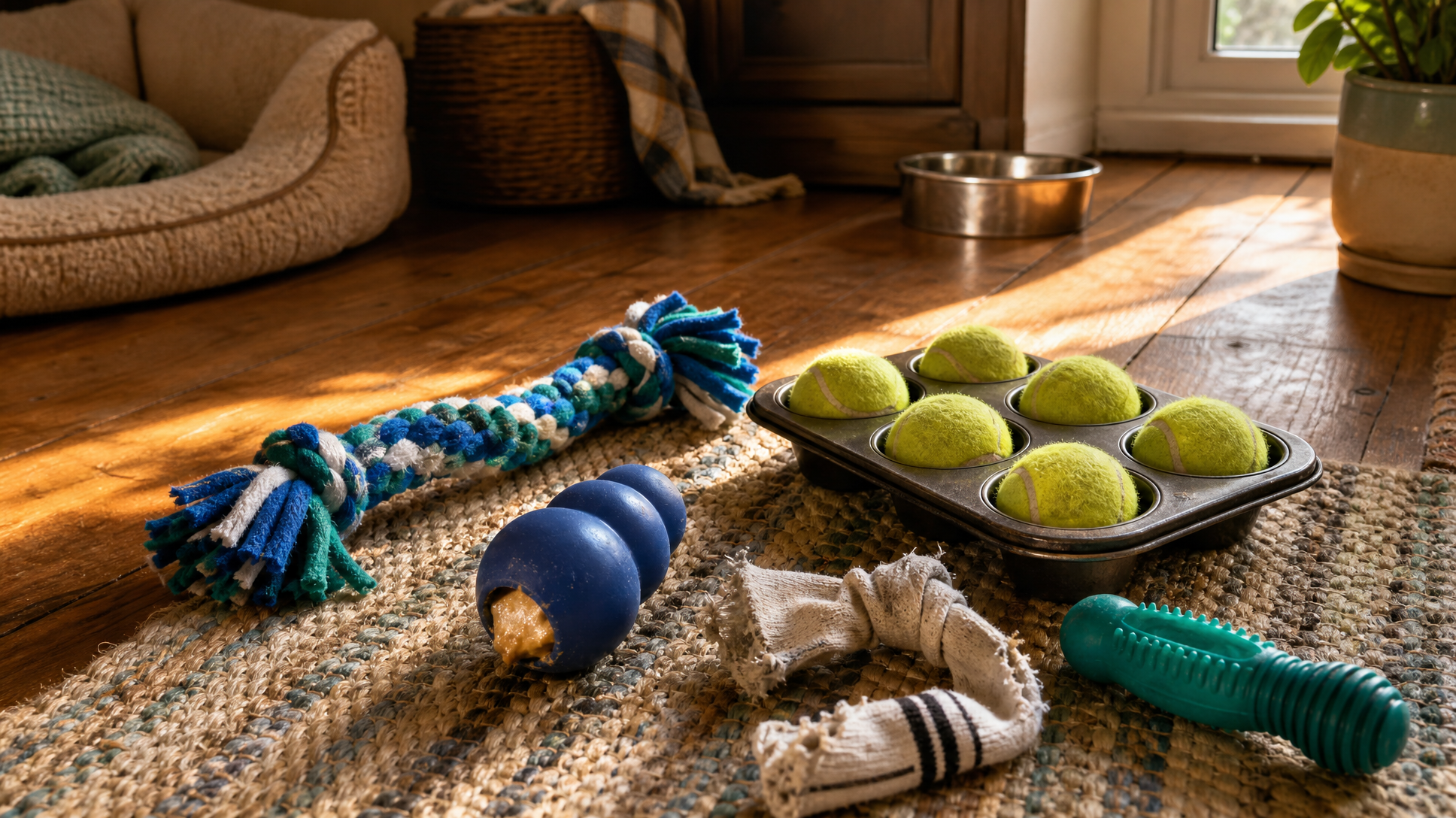
Braided fleece tug toys are probably the best DIY dog toy you can make. Cut three strips of fleece fabric (avoid anything with elastic or synthetic coatings), braid them tightly, and knot both ends. Fleece is soft, doesn't fray into sharp threads, and holds up well during tug sessions. If your dog does start pulling pieces off, it's easy to spot and replace.
Muffin-tin puzzle feeders are less a toy and more a boredom-buster, but they work brilliantly for food-motivated dogs. Drop a few kibbles or small treats into the cups, cover some with tennis balls, and let your dog sniff out the goods. No construction required, no risk of ingestion, and it genuinely tires them out mentally.
Frozen treat toys — filling a rubber Kong-style toy or a silicone mold with dog-safe ingredients and freezing it — are a staple for a reason. The frozen element extends the chewing session significantly, and as long as you're using dog-safe ingredients (plain peanut butter without xylitol, plain yogurt, banana, or their regular kibble soaked in broth), the risk is low.
Snuffle mats made from rubber sink mats and strips of fleece are another winner. Thread the fleece through the holes in the mat, tie them off, and you've got a foraging toy that keeps a dog busy for a solid stretch. The fleece strips can come loose over time, so check it periodically — but it's one of the more durable DIY options.
The materials that look fine but aren't
This is where most DIY toy advice goes quiet, and it shouldn't.
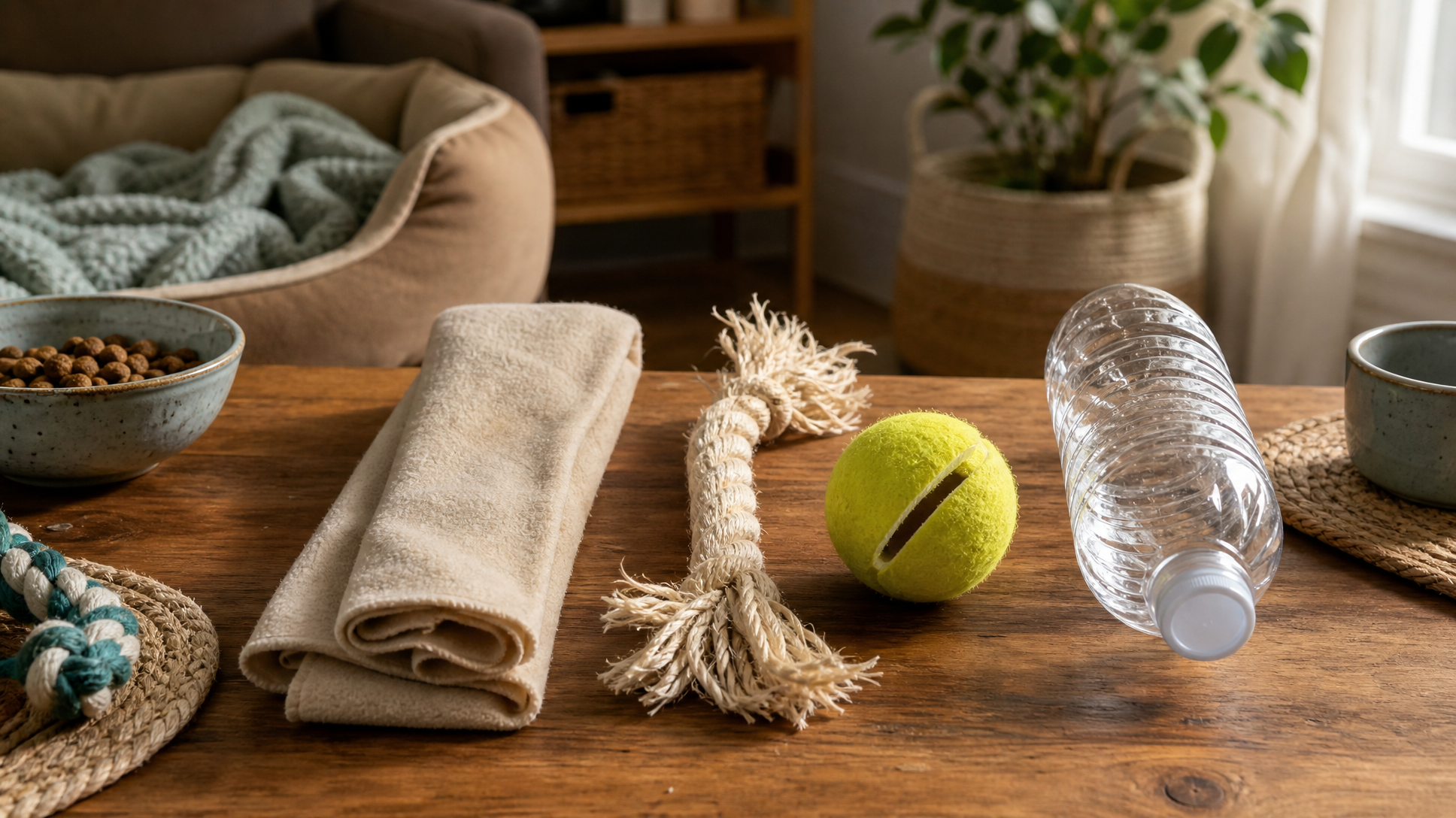
Old socks and stockings are one of the most-shared DIY toy ideas online, and they're also one of the more problematic ones. The issue isn't the sock itself — it's that dogs learn socks are toys. Once that association is made, your dog doesn't know the difference between the play sock and the one you left on the bedroom floor. Fabric ingestion is a real cause of intestinal blockages in dogs, and a knotted sock gives a determined chewer something to unravel and swallow.
Tennis balls with cuts or slits are popular as treat-dispensing toys, but the slit can act like a suction trap — catching a dog's tongue or lower jaw, especially in medium and large breeds. Standard tennis balls also have a felt exterior that wears down tooth enamel with heavy chewing. If your dog is a serious chewer rather than a light fetcher, tennis balls aren't the right material.
Rope toys made from synthetic cord, twine, or yarn carry a specific danger: when ingested, long strands of string or yarn can cause what vets call a linear foreign body — essentially the material anchors somewhere in the digestive tract and the intestine bunches up around it. It's one of the more serious toy-related emergencies. Natural cotton rope is safer, but even that needs to be retired once it starts to fray significantly.
Plastic bottles — the kind you see in "crinkle toy" tutorials — can splinter into sharp shards when a dog bites down hard enough. The crinkle sound is genuinely stimulating for dogs, but a standard water bottle isn't built to withstand real chewing pressure.
Glue, paint, and craft supplies of any kind are a hard no. Even non-toxic craft glue isn't formulated with dog chewing in mind, and anything that could chip, peel, or dissolve in saliva is a risk not worth taking.
When to skip the DIY and just buy the toy
There are four situations where a purpose-made toy is genuinely the better call — not because homemade is always inferior, but because the stakes or the mismatch are too high.
If your dog is a power chewer. Dogs who destroy a standard toy in under ten minutes need something specifically engineered for that behavior. Homemade options — even well-made ones — aren't built to withstand the bite pressure of a determined Rottweiler or Malinois. Toys rated for aggressive chewers use materials tested for that purpose. A homemade toy in those jaws is a swallowing hazard waiting to happen.
If your dog has a history of eating non-food items. Some dogs will ingest fabric, foam, stuffing, or rope without hesitation. If yours has ever needed something removed from their stomach, DIY fabric or rope toys aren't worth the risk. Stick to solid rubber or purpose-made indestructible options.
If you're buying for a puppy. Puppies chew everything and have less predictable bite patterns than adult dogs. They're also more likely to swallow pieces they've pulled off. It's worth investing in toys that have been designed and tested with that behavior in mind, at least until you understand your specific puppy's chewing style.
If the toy needs to do a specific job — like dental cleaning, anxiety relief, or extended solo play — a purpose-built design will do it better. A chew toy shaped to reach between teeth actually reaches between teeth. A braided fleece rope, however lovingly made, doesn't.
For large and strong breeds especially, the collar and gear they wear matters as much as the toys they play with — if you're outfitting a big dog, it's worth reading up on how to choose the right collar for large and strong breeds to make sure the rest of their setup is equally solid.
The honest middle ground
DIY toys aren't a bad idea — they're a partial idea. Use them for enrichment, for puzzle feeding, for light play with a dog you know well. Rotate them with purpose-made toys so you're not relying on a knotted fleece strip to carry all the chewing load. And retire anything the moment it starts to fall apart, whether you made it or bought it.
The best toy setup for most dogs is a mix: a few solid, chew-rated toys that can take real pressure, an enrichment option or two for mental stimulation, and the occasional homemade treat puzzle when you're feeling creative and the stakes are low.
Browse Petocart's full range of dog toys and accessories — free shipping on eligible orders across the USA.
Frequently Asked Questions
Are knotted rope toys safe for dogs?
Natural cotton rope toys are generally safe for supervised play, but they need to be monitored closely. Once the rope starts to fray and individual strands come loose, retire it — ingested string or rope fibers can cause serious digestive problems. Synthetic cord or yarn is riskier and best avoided altogether.
Can I use a regular tennis ball as a dog toy?
For light fetch play with a dog who doesn't chew aggressively, a standard tennis ball is generally fine. The concerns arise with heavy chewers — the felt exterior can wear down tooth enamel over time, and a ball with a cut or slit can trap a dog's tongue. If your dog chews rather than just fetches, look for balls designed specifically for dogs.
What household materials are safe to use for DIY dog toys?
Plain, untreated fleece fabric is one of the safest options — it doesn't fray into dangerous threads and is soft enough not to damage gums. Natural cotton rope (thick gauge, not thin twine) is another reasonable choice for braiding. Avoid anything with glue, paint, elastic, synthetic coatings, or small parts that could be chewed off and swallowed.
How do I know when a toy — DIY or store-bought — needs to be thrown out?
Replace any toy that has visible cracks, sharp edges, significant fraying, or pieces that can be pulled off. For fabric toys, if your dog has removed a chunk or the seams are coming apart, it's done. For rubber or plastic toys, any cracking or splintering is a sign to retire it immediately. A good rule of thumb: if you'd hesitate to let a toddler play with it unsupervised, it's time to toss it.