Cart
0

You picked up a dog toy last week because the tag said 'eco-friendly' and 'sustainably made.' It felt like the right call. Then you got home, looked closer, and realized the label didn't actually explain anything. No materials listed. No certifications. Just a leaf icon and a vague promise.
You're not imagining it. Greenwashing in the pet industry is real, and it's gotten sophisticated enough that even careful shoppers get fooled. The good news: once you know what signals actually matter, the noise clears up fast.
Why 'Eco-Friendly' Alone Means Nothing
The phrase 'eco-friendly' has no legal definition in the United States when used on consumer product labels. The FTC has guidelines — called the Green Guides — that discourage vague, unqualified environmental claims, but enforcement is limited and the term itself isn't regulated the way, say, 'USDA Organic' is. Any brand can print it on a bag.
This matters because the pet industry is enormous, and marketing budgets are big enough to make almost anything sound responsible. 'Natural', 'green', 'planet-conscious', 'earth-friendly' — these phrases cost nothing to print and prove nothing on their own.
So what should you actually look for?
The Signals That Are Worth Something
1. Specific Materials, Not Adjectives
A product that's genuinely made with sustainability in mind will tell you exactly what it's made from. 'Recycled PET' (plastic bottles turned into fiber), organic cotton certified by GOTS, natural rubber, hemp, or FSC-certified wood are concrete claims that can be verified. 'Eco materials' or 'green fabric' are not.
When shopping for your dog or cat, look for the material breakdown in the product description — not just the headline claim. If a brand is proud of what went into a product, they'll tell you specifically.
2. Packaging Is Part of the Story
A lot of genuinely sustainable effort goes into what surrounds the product, not just the product itself. Brands that are serious about reducing waste tend to use minimal packaging, avoid mixed-material pouches that can't be recycled, and clearly label what is and isn't recyclable.
On the flip side, a 'natural' pet treat wrapped in three layers of non-recyclable plastic film is a contradiction worth noticing. The product's environmental footprint doesn't end at the ingredient list.
3. Durability Is a Sustainability Factor — a Big One
This one gets overlooked constantly. A cheap toy that falls apart in two weeks gets thrown in the trash. A well-made toy that lasts a year doesn't. From a waste perspective, durability beats 'recycled content' more often than people realize.
When you're evaluating pet products — especially toys, collars, and accessories — ask how long they're designed to last. A heavy-duty dog collar built from quality leather or reinforced nylon that holds up for years is, in a real sense, more sustainable than a flimsy alternative marketed as 'eco.' The right collar for a large or strong breed is a good example: getting the fit and build quality right the first time means you're not replacing it every few months.
4. Third-Party Certifications (the Ones That Require Actual Auditing)
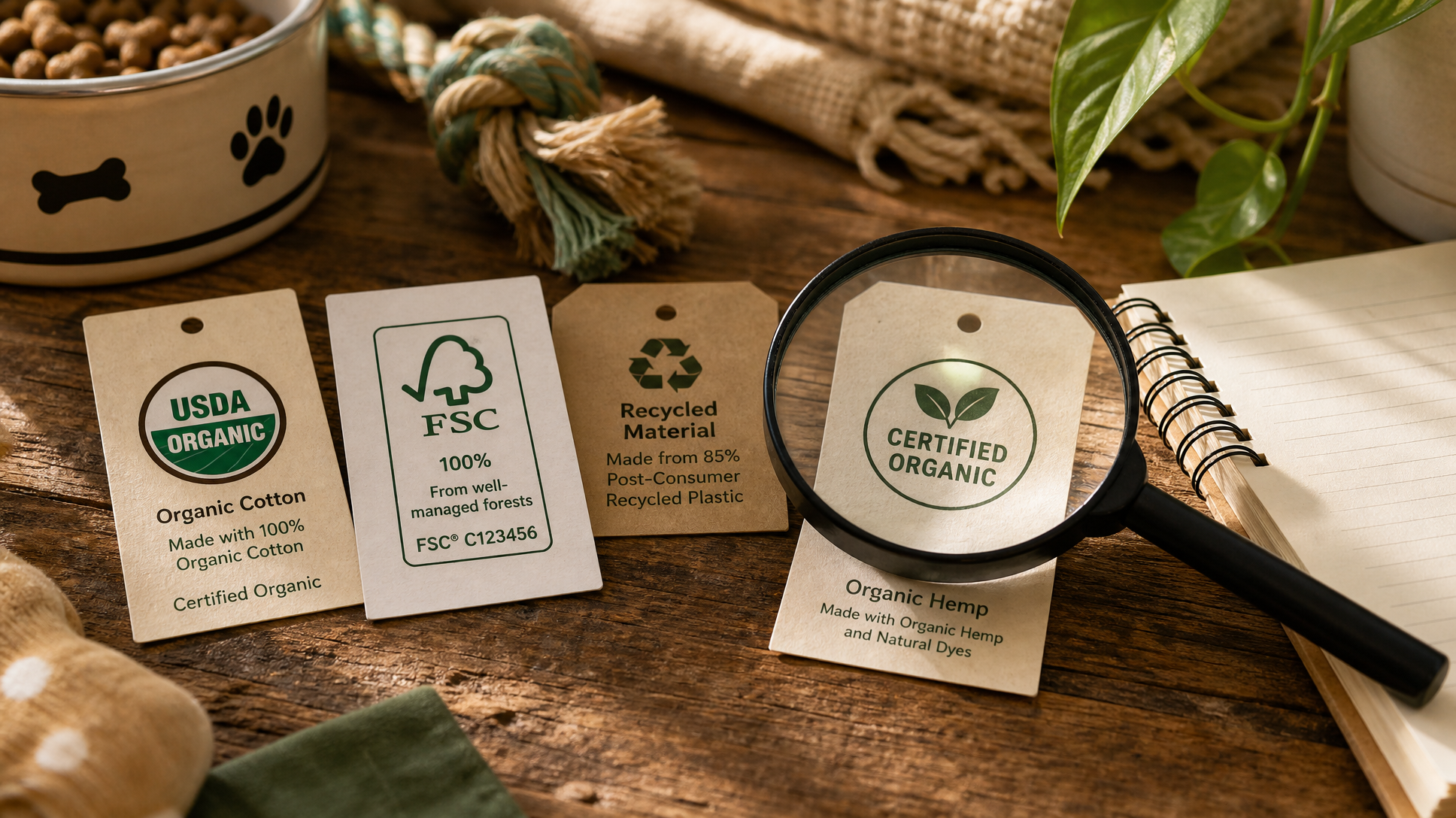
Certifications are only meaningful when an independent body does the verifying — not the brand itself. A few worth recognizing:
- USDA Organic — for food and treat ingredients, this is a federally regulated standard with real requirements.
- GOTS (Global Organic Textile Standard) — covers organic fiber in textiles like pet bedding and soft toys.
- FSC (Forest Stewardship Council) — relevant for wood-based products like bird perches or small animal habitat materials.
- Leaping Bunny / PETA cruelty-free — these address testing practices, not environmental impact, but they're independently verified.
A brand that has earned one of these certifications will make it easy to find. If you have to dig for it, it might not exist.
The Claims That Are Almost Always Filler
Not every vague phrase is a lie — sometimes it's just lazy marketing. But these are the ones that should prompt a follow-up question rather than a purchase:
- 'All-natural' — natural doesn't mean safe, non-toxic, or sustainably sourced. Arsenic is natural.
- 'Green' or 'planet-friendly' — unverifiable without specifics.
- 'Sustainable packaging' — sustainable compared to what? Look for the actual material and recycling instructions.
- 'Eco-conscious brand' — a values statement, not a product claim. Judge the product, not the brand's self-description.
How to Apply This When You're Actually Shopping
You don't need to spend an hour researching every cat toy or bag of treats. A quick two-step check covers most situations:
- Read the product description for specifics. If it mentions real materials, certifications, or packaging details — good sign. If it's all adjectives — pause.
- Think about lifespan. Is this product built to last, or is it likely to end up in landfill within a month? Quality construction is a sustainability argument in its own right.
Across categories — food, toys, grooming products, accessories, bedding — the same logic applies. Specificity is trustworthy. Vagueness isn't.
A Note on Pet Food and Treats
Pet food is where the environmental conversation gets genuinely complicated. Ingredient sourcing, supply chain transparency, and manufacturing practices all matter, but they're rarely summarized on a front label. For food and treats, the most reliable signals are USDA Organic certification for specific ingredients, clear country-of-origin labeling, and brands that publish their sourcing standards rather than just claiming them.
If a brand's sustainability story lives entirely on its marketing page and nowhere on its product label or third-party verification, treat that story with appropriate skepticism.
Shop With Your Eyes Open
Caring about your pet's environmental footprint is worth the extra minute of label-reading. The brands that are doing the real work make it easy to see — because they want you to know. The ones leaning on leaf icons and feel-good language are counting on you not to look too closely.
Browse Petocart's curated range of pet essentials — quality products across every category, with free shipping across the USA. Use code WELCOME5 for 5% off your first order.
Frequently Asked Questions
Is 'natural' the same as 'eco-friendly' on pet product labels?
No — and this distinction matters. 'Natural' typically refers to ingredient origin (not synthetic or artificial), while 'eco-friendly' is supposed to describe environmental impact. Neither term is strictly regulated on pet product labels in the US, so neither alone guarantees anything. Look for specific certifications or material disclosures instead of relying on either word at face value.
How do I know if a pet product certification is legitimate?
Legitimate certifications are issued by independent third-party organizations — not the brand itself. USDA Organic, GOTS, FSC, and Leaping Bunny are examples of programs with published standards and audit requirements. You can usually verify a brand's certification status directly on the certifying body's website. If a certification appears on a label but isn't searchable through the issuing organization, be skeptical.
Does buying durable pet products really make a sustainability difference?
Yes, meaningfully so. Every product that ends up in landfill after a short lifespan represents wasted materials, energy, and packaging — regardless of how it was originally marketed. A well-constructed collar, bed, or toy that lasts years reduces that waste cycle significantly. Durability is one of the most underrated sustainability factors in pet shopping, and it's something you can evaluate directly before buying.
What should I look for in eco-friendly pet food packaging specifically?
Look for packaging that clearly identifies the material it's made from and tells you how to dispose of it — recyclable, compostable, or store-drop-off eligible. Avoid pouches that combine multiple materials (like foil-lined plastic laminates) without any recycling guidance, as these typically end up in landfill. Some brands also participate in take-back or recycling programs, which is worth checking on their website.